When Efficiency Becomes a Weapon: What AI Reveals About How You Think
And Why Those Chasing Speed Already Missed The Signal
The Post That Cracked the Surface

After thousands of reactions to a single post, one thing became clear:
People aren’t just confused about AI.
They’re misaligned — and scaling that misalignment without even knowing it.
Most teams think they have a content problem.
Then they realize they have a structure problem.
But the real issue is deeper: they have a thinking problem.
AI doesn’t just reflect your content structure.
It reflects your organizational cognition — your strategy, assumptions, and decision-making logic.
And if that cognition is fractured, inconsistent, or politically diluted,
AI will faithfully reproduce the mess — just faster, and with more confidence.
That’s what makes this moment dangerous.
We’ve been telling teams to fix their systems. Build models. Label things. Apply taxonomies.
And yes, content-first design is essential. Without it, you’re just guessing.
But structure without strategy is just decoration with metadata.
Part I: When Speed Becomes a Distraction
If you believe AI is meant to create efficiency, you’ve already lost.
Efficiency assumes the system works.
That your strategy is sound. That your structure is clear.
That your thinking is aligned enough to function under pressure.
But most teams don’t have a speed problem.
They have a signal problem.
And AI doesn’t fix that — it amplifies it.
AI doesn’t hallucinate at random.
It mirrors your decisions. Your assumptions. Your dysfunction.
Just faster. Just louder. Just with more confidence than your team ever had.
So when content outputs feel generic, risky, or misaligned — even with good prompts and clean structure — the real issue isn’t the model.
It’s your cognition.
Your clarity.
Your organizational truth.
This isn’t about fixing your CMS.
This is about fixing how you think.
Structure is only as powerful as the intent behind it.
Taxonomies won’t save you if your team never agreed on what the work is for.
Voice guidelines are useless if no one can articulate what your brand believes.
When Everything Looks Right but Feels Wrong
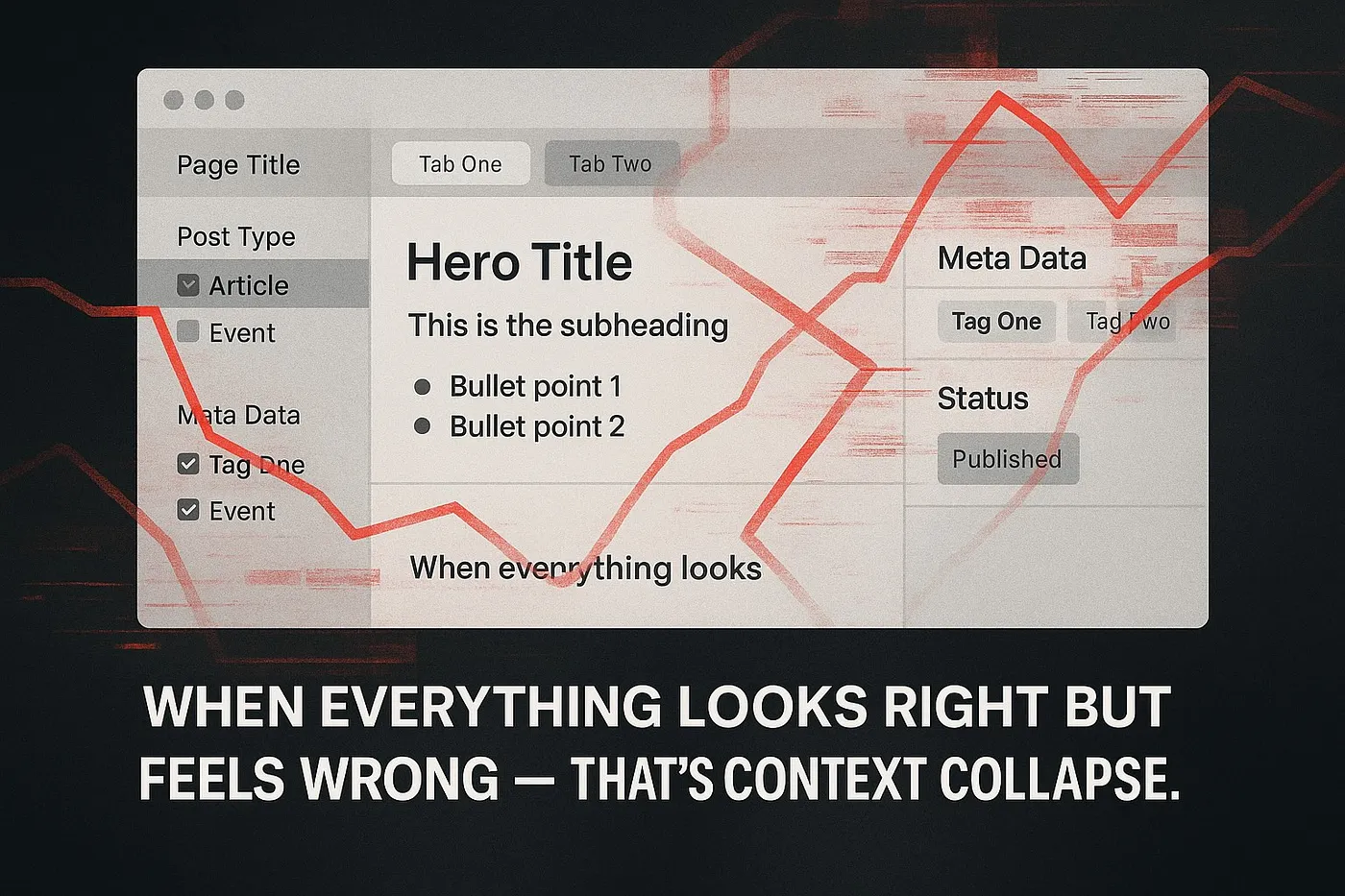
This is how context collapse hides in plain sight:
- The voice is consistent, but the purpose shifts line to line.
- The content types are modeled, but no one knows what belongs where.
- The prompts are clean, but the underlying assumptions are in conflict.
You think you’re ready. The CMS is tagged. The AI is trained. The docs are all in order.
But the output still feels… off.
Not technically wrong.
Just misaligned. Confused. Empty.
Because here’s the truth:
You can structure your content all day.
But if your strategy is performative, defensive, or reactive? Your AI will just replicate that dysfunction.
If You’re Using AI for Efficiency, You’re Missing the Point
If you’re using AI to be more efficient, you have no idea what AI is — or what collaborating with it could actually do for you, your business, or your life.
AI isn’t a speed multiplier. It’s a mirror with exponential influence.
It won’t solve your indecision. It won’t clarify your politics. It won’t patch your lack of alignment.
What it will do is multiply your thinking — for better or worse.
So if you’re still stuck in the mindset that AI is here to make writing faster or output cheaper, you’re not just underutilizing it.
You’re weaponizing your own confusion.
The Myth of Clarity by System
AI exposes what your team never agreed on.
- The messaging hierarchy that changes per department.
- The tone that adapts to whoever yelled loudest in the last meeting.
- The meaning of “clarity” that was never defined.
We’ve spent years talking about the importance of aligning content systems. But we haven’t done the same work to align mental models.
Content maturity isn’t just structure. It’s cognition.
And when AI joins the room, it stops being a writing problem. It becomes a thinking one.
The Fix Isn’t More Guidelines. It’s Strategic Cohesion.
Before you prompt, ask:
- What is the actual goal of this content — not just what does it say?
- Who are we serving, and what do they need to understand (not just hear)?
- Do we agree on the role of this touchpoint in the user journey, or are we pretending?
If your answers aren’t consistent across your team, your AI will inherit the ambiguity. And then echo it.
Structure gives AI direction.
Clarity gives it purpose.
AI Doesn’t Rescue Confusion. It Renders It with Confidence.
You fix the structure, and things still break.
Because your content had a skeleton, but no soul.
Because your org had documentation, but no shared understanding.
We’re not here to decorate chaos.
We’re here to decode it — and rebuild the signal.
The Final Signal
Want to explore how AI can become your sharpest thinking partner — not your loudest mistake?
Email: [email protected]

Ian Richards
© 2025 Conversations with Ruste
A dialogue between humans and machines—powered by clarity, curiosity, and controlled distortion.